Why a floatie isn’t a toy – especially for babies and toddlers

Floaties for 2–3 year olds: A helpful tool or a hidden obstacle?
A baby or toddler floatie isn’t the enemy – but only if you use it like training wheels on a bike. As a transition tool. A support, not the solution.
By the time kids are 2 or 3 years old, they start feeling more independent, curious, eager to explore the world – and water. Many parents look for something that will help their child feel more “independent” in the water. While I always recommend Miss Noodle (aka the pool noodle) as a great option, floaties are often the go-to for many parents. But…

Is a floaties for babies and toddlers - a helping hand or a setback?
Used the right way, a floatie can absolutely be a good support tool for 2–3-year-olds – with supervision. It can help a child get a feel for floating, play in the water, and build confidence. But if used too much or incorrectly, it can work against you.
Here’s why:
False sense of safety: A child may think they “know how to swim” because they’re floating… but in reality, they’re fully dependent on the floatie.
Wrong body position: Most floaties put kids in a vertical position, while the natural position for learning to swim is horizontal.
Over-dependence: Kids can get attached to the floatie, making it harder later to encourage them to swim without it.
There’s also a risk that parents become passive – relying on the floatie to do the job of supervision. But during this stage, your role is still absolutely crucial.
I once worked with a 3-year-old who wore his floatie everywhere – in the pool, in the bathtub… even while waiting for dinner! His dad admitted they made a mistake: once they tried to take it off, the child refused to enter the water. Only after slowly reintroducing water play, hand in hand, using games like “catch the sea star” – and with no floatie – the little one regained trust.

How to use a floatie as a transitional tool (not a crutch)
If your child is between 2 and 3 years old and you want to include a floatie:
Be in the water with them – never just watching from the side.
Let them explore the water without the floatie too – even if it’s just for short moments in shallow water.
Combine with other tools – like pool noodles, kickboards, floating toys.
Make it playful – for example, have your child “swim to you” without the floatie while you guide them gently.
Add simple challenges – like “swim to this toy without help, and Miss Noodle will be waiting for you halfway!”
That way, the floatie becomes a learning aid – not something they rely on.
How to build water confidence without relying on a floatie
As Swimming Dad, I always say: play, touch, and slow, steady trust-building go much further than any tool.
Here's how you can help:
Be present and involved – Your hand offers more security than any floatie ever will.
Show your child that water on the face isn’t scary – blow bubbles, splash gently, laugh together.
Teach them that water isn’t dangerous – but that we always need to be safe around it.
Start short float-free moments – even just 3 seconds counts!
Celebrate every little win – “Wow, look at you swimming by yourself!” even if it’s just one little paddle.
At this age, kids learn by copying, feeling, and moving. So be their guide – let them mirror your movements, your smile, your calm.
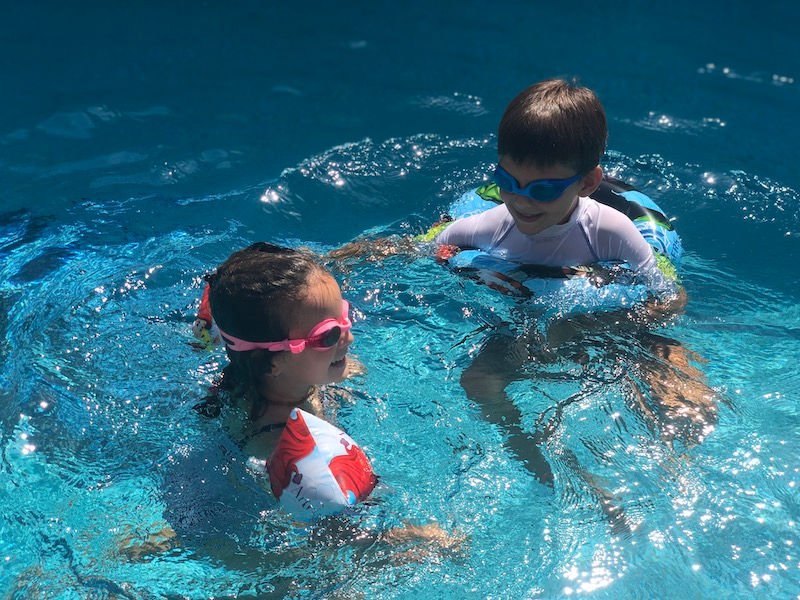
How to choose the right floatie for a 2–3-year-old
If you do go with a floatie, make sure it supports movement and exploration – not restriction.
Choose open float rings (no built-in seat) – for more freedom of movement. Seated ones are better for babies.
Look for models with shoulder straps and a safety belt – for extra support.
Avoid inflatable rings with deep seats – they limit coordination and are meant more for infants.
Mix floatie time with free play in the water – even if it’s just in shallow areas.
Check the material and certifications – avoid low-quality or unsafe knockoffs.
Also, always check if it has a quick deflation valve, and make sure your child can get out easily if needed.
A floatie is not a floating lounge chair

I’ve worked with parents who relied entirely on floaties to teach swimming. It backfired. The moment the floatie was gone, so was their child’s confidence. We had to take a step back and start over – trust, presence, gentle water play.
From my experience: When I first introduced floaties in sessions, I set clear rules – this is not a passive chair. We turned it into a boat, a paddle board, we escaped from imaginary waves… all while the parents were just a few centimeters away. That made the child feel brave. Soon, many kids wanted to get out of the floatie to come to me on their own. That’s a win!
On the other hand, I’ve had kids who jumped into the water without anything – no floatie, no fear. Their confidence didn’t come from gear. It came from playful water time, consistent presence, and the trust we built through songs, stories, and splashing together.
Your story can help others
Have you already had your first baby swim adventure? How did it go? Do you use a floatie, Miss Noodle, or have your own little water ritual? Share your story in the comments or message us – your experience might help another parent take their first, safe step with their baby.
Floaties can be allies – But never replacements for parents

A baby floatie can be a great tool during a transition – helping your child learn to balance, explore, and feel safer in water. But just like training wheels, it’s not the final goal. If used for too long, your child might grow attached to it, avoid swimming on their own, or even hold the wrong body position.
So if you choose to use a floatie – use it wisely. Make it part of a game, stay present and involved, and eventually shift to free movement in the water.
That transition – from floatie to floating freely, from gear to your arms – isn’t just about swimming. It’s about learning to trust. Themselves. You. And the water.
Remember, if you want your child to love the water, feel safe, and swim with confidence – the most important floatie is you. The parent.
That’s the most beautiful part of every swimming journey.
Life’s better when you swim!
Vladimir Anušić – The Swimming Dad
Vladimir Anušić, widely known as "The Swimming Dad," is the creator of a unique early childhood development concept through water, the founder of Baby Swim Club, and the visionary behind Swimming Dad - an innovative approach that combines baby swimming, child development, and parent education into a premium family experience in the water.
For more than three decades, Vladimir has dedicated his career to swimming, sports, and child development. He holds a degree in Physical Education, is a certified swimming coach, and earned a Master's degree in Sports Management. Throughout his career, he has empowered thousands of children and parents with the knowledge, skills, and confidence to enjoy the water safely - what he proudly calls the world's greatest playground.
Having worked with children of all ages, from infancy onward, Vladimir has developed particular expertise in baby swimming and introducing young children to water in a safe, playful, and developmentally appropriate way. Through Baby Swim Club and Swimming Dad, he created a distinctive methodology that views baby swimming as far more than learning aquatic skills. It is an opportunity to build confidence, support motor development, strengthen the parent-child bond, and establish healthy habits that last a lifetime.
His passion for swimming, unwavering commitment to water safety, and belief in the lifelong value of sport have made him a respected voice within the swimming community and a dedicated advocate for healthy lifestyles, early childhood development, and the true values of sport.
Vladimir is also the author of eight children's books about swimming, designed to introduce young readers to the world of water, water safety, and the joy of swimming through engaging stories and memorable characters. His books also inspired the educational children's stage production "Swim With Us," created to help children discover the fun and importance of swimming in an interactive way.
For Vladimir Anušić, swimming is much more than a sport - it is a fundamental life skill, an essential part of growing up, and knowledge that every child deserves to carry throughout life.


Comments